
14 April, 2025, Monday
What would the world be like if we did not exploit animals? What would our lives look like together with “farm animals”, wildlife, and domesticated species?
In a world where a new world war is being discussed at the same time people are fighting against exploitation, wars, and inequality we interviewed the German artist Hartmut Kiewert who is also looking for answers to these questions.
We discussed Kiewert’s art through which he presents a utopian history without animal exploitation, how we can make violence against animals visible through art and his future projects.

Visual representations of animal rights usually recreate the moments of their exploitation. Your work on the other hand, presents a utopia. Do you believe the production of the utopian theme is strengthening for vegan activists and the vegan struggle?
I actually do sometimes get feedback from activists, that they feel encouraged and strengthened through my imagery, as it anticipates our goals as animal liberation movement and hence gives hope. Similar maybe as “farmed animal” sanctuaries do, as places of concrete utopia. I think that it is strategically very important for emancipatory movements to envision counter-narratives to the current status quo and also try out and evolve new forms of relation, both, in between humans and between humans and non-human animals.
Speaking of utopian scenarios and possibilities it is important to point out, that these are not meant to be blueprints, but rather an attempt to open up the debates and practices beyond today’s power structures. I think that the imagination of how good life could be for every being, if we get rid of all systems of oppression, is a big motivation and is probably more powerful than just the critique of the structures of domination and exploitation alone.

Hartmut Kiewert, Friends VI, 2024, oil on canvas, 190x150cm
How does it make you feel to create a vegan world?
Well, I enjoy the process of creating scenarios of a world in which slaughterhouses, fattening sites and other means of animal exploitation do no longer exist and human and non-human animals are free and encounter on equal footing.
What is your opinion on the recreation of violence in visual sources of animal rights?
I think it is crucial to raise awareness of what atrocities humans are doing to other animals and the work of research activists, that reveal what is happening inside the animal industries or other sectors of animal exploitation is very important.Nevertheless two things are very relevant to take into account in this context. First we need to be aware, that the confrontation with these footage can traumatize people, especially people who really have compassion with other animals. So we have to be careful how we show and contextualize these footage. And second we should avoid a sheer paternalistic approach, which sees other animals only as victims and undermine their agency.

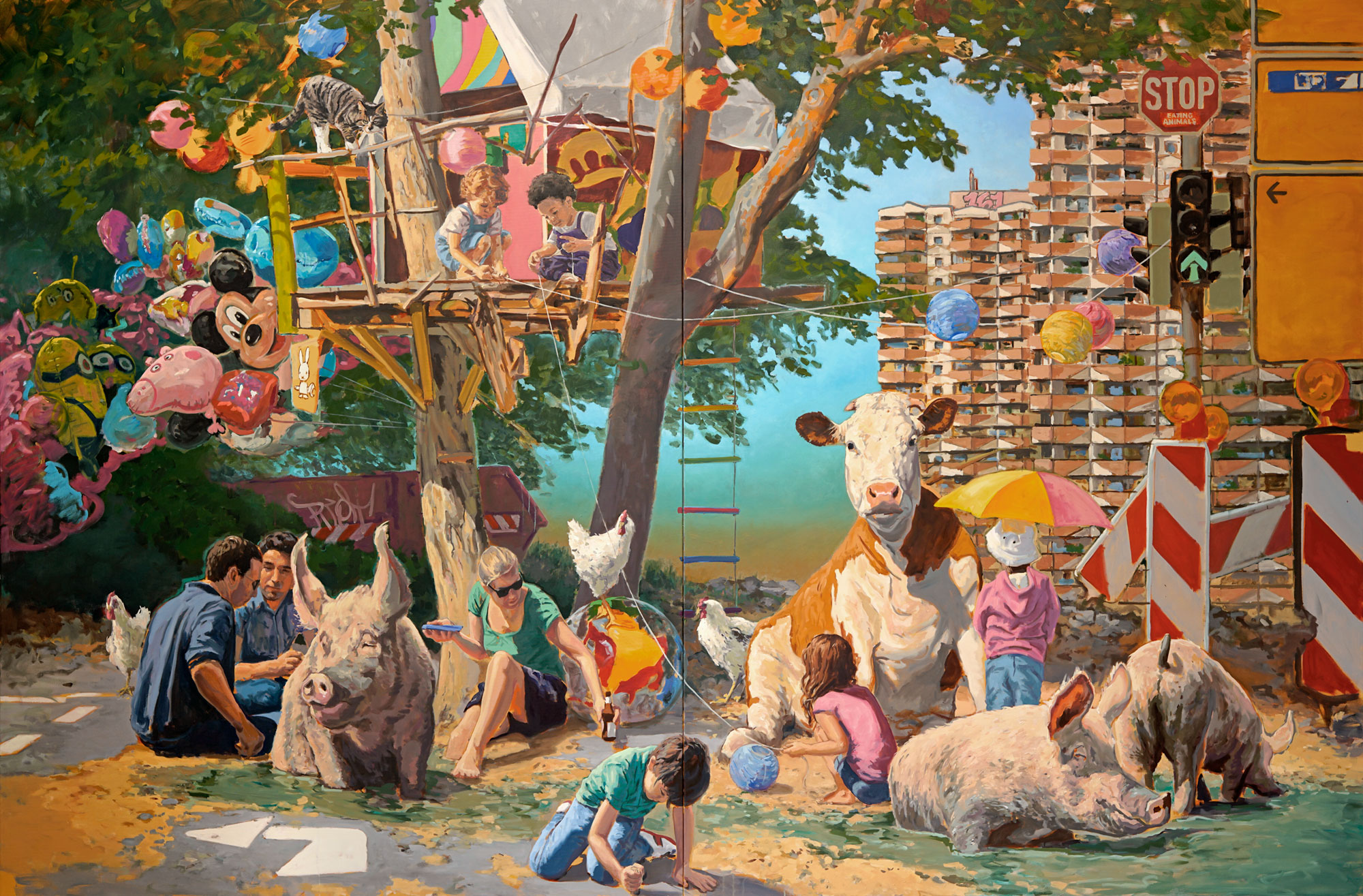
Hartmut Kiewert, Neighborhood, 2024, oil on canvas, 250x380cm
What do you think we might do to create a vegan world?
There is of course no short answer to this question, as the animal rights / animal liberation movement is fighting for a world without animal exploitation with all different kinds of tactics and strategies for decades already and besides some smaller wins here and there, the only thing that seem to change on a larger scale, is that the animal exploiting food industry now also invests in the vegan market segment, whilst at the same time the numbers of slaughtered animals still are rising at global level. So in my opinion we can not create a vegan world inside a capitalist framework. We need to overcome the patriarchal, capitalist ways of thinking and producing, that led us to the edge of a global ecological and social breakdown. We need to foster radical other forms of building our social relations beyond market, work, value and state, which are no longer based on exploitation, exclusion and violence, but on solidarity, inclusion and empathy.
So I see the question of how to build a vegan world as entangled with other social and environmental movements. Nevertheless, on the personal level the first step of course is to stop consuming products made through animal exploitation and go vegan. The next step then is to go get involved into emancipatory struggles for the liberation of all beings.

Hartmut Kiewert, Ruine II, 2017, oil on canvas, 60x80cm
Do you plan to exhibit your work in Turkey?
At the moment there is nothing planned, but generally I would be glad to exhibit my work in Turkey of course. For all those who are in Berlin during the next months: there is a large solo exhibition at Zitadelle in Berlin Spandau. It is open every day and runs until August 18th 2024.
Interview: Cansu Özge Özmen, Aslı Alpar


Bir yanıt yazın