
From October 8–12, at the 12th Bozcaada International Ecological Documentary Festival (BIFED), one of the films we watched was Lace Relations, jointly directed by four women filmmakers from Austria and Nigeria.
The documentary takes viewers on a journey between the quiet Austrian town of Vorarlberg and the vibrant, bustling markets of Lagos, Nigeria, weaving a story that raises new questions: “Who tells our story, who profits, who remembers?”
As we witness the intertwined lives of Ireti Bakare-Yusuf the daughter of a famous textile queen in Lagos and a journalist and Grete Bösch a retired lace exporter from Austria the film offers an opportunity to reconsider how the colonial legacy has transformed over the centuries through the slave trade and the persistence of trade relations despite prohibitions.
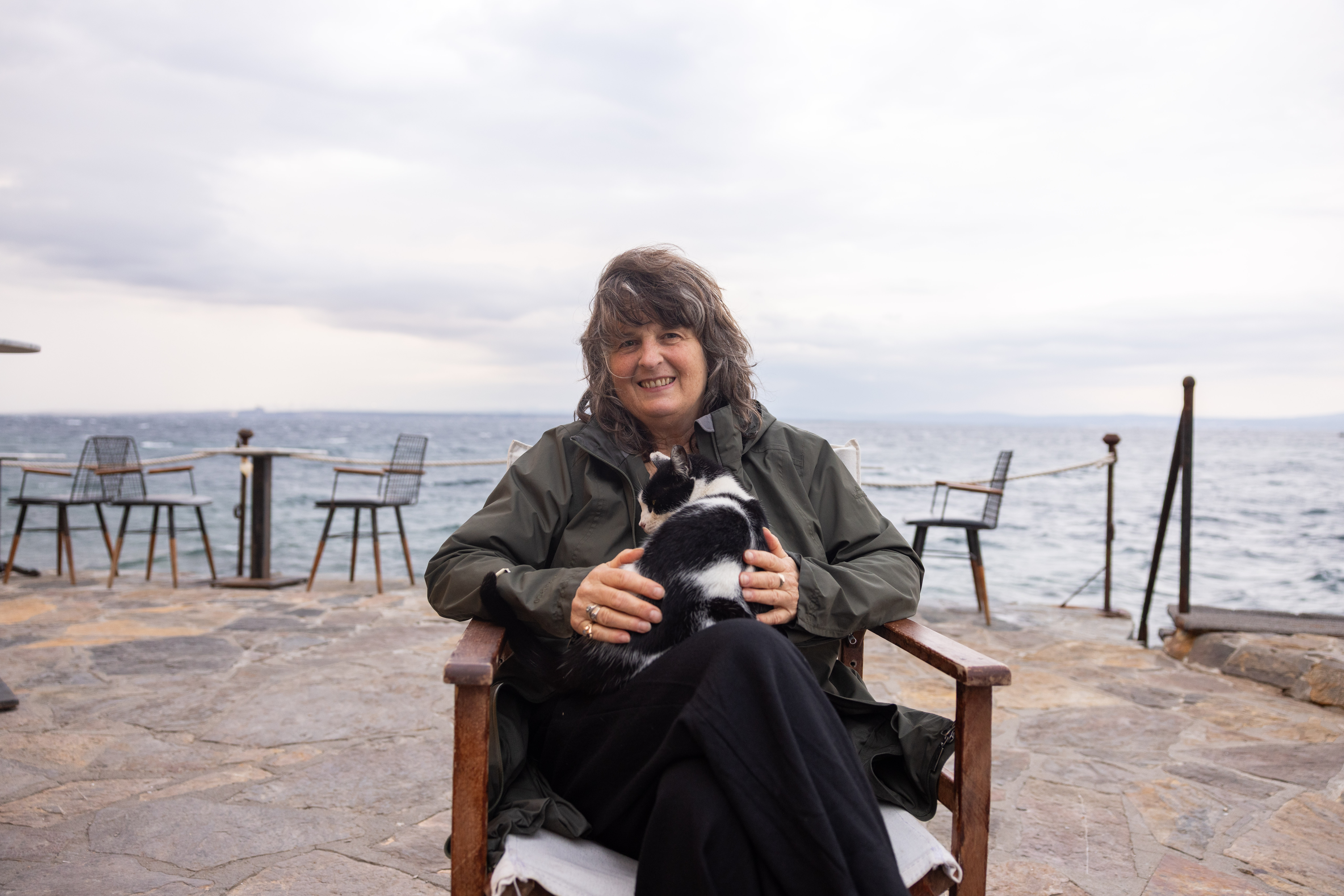
We met with Katharina Weingartner, one of the four directors who weave the story layer by layer like lace – with an elegant, patient and enduring narrative – at BIFED and asked her what we were curious about the film.
How is the festival going for you so far?
Oh, I love this place. It’s already my third time in a way. Although the first time I was Covid, so I couldn’t be here. It was virtual. But I… My film in 2020 already won here. And then I was also in the all-women’s jury last year. And we had a blast. And this year I enjoy it tremendously. It’s such a special place. It’s so amazing. The kind of people you meet here. The incredible closeness with the audience. And how the people feel cinema here. And how political people here are. And especially the many great women I met here. It’s very inspiring. And this is really what keeps me going as a filmmaker. This kind of interaction is great.
After the screening of Lace Relation, we got to hear your personal impressions of the film. How did you decide to explore the connection between Lace textiles and colonial history through these impressions?
Well, I am only one director of four, so I can only speak for myself. I cannot speak for the other three women that I made the film with. But the idea for the film is from the region where I grew up in Austria. It’s the textile area where the textile factories turned into a form of a Silicon Valley. It’s the richest part of Austria, very industrial. And after working a lot in other countries and on subjects that are far away from my home, me and my collaborator, we decided we want to do something closer to our doorsteps and look at the conditions for the wealth in our region. And then we started researching and scratching on the surface, and then we found all of these incredible stories going all the way back to slavery, which we had not had on our radar before. And so I think it has to do with looking closer to home, and not only as a documentary filmmaker looking for stories far away.

At times there is a Yoruba vibe and other times a Catholic one, bringing together two very different cultures like Nigeria and Austria. How did that create dramatic tension or dialogue in the film?
Well, yes, there is tension in the film, but the tension is also in the collaboration. And that was a very interesting process to work with filmmakers from Austria, from this Catholic, very patriarchal background. Wealthy and safe, but also cursed with a kind of silence, because there is a lot of things we cannot speak about in the culture I come from. And the other two filmmakers come from a very strongly patriarchal society. But you can really feel them. They are very emancipated feminist women. It took us a long time to find a common story. And I think the tension in the team is also still there in the film. And this is not something that we deny, but we had to work through it and somehow go through this. We call them the lucky cats in Austria, the ones that have these three colors. Really? Oh, lovely. My mother has one of those. Yes, it was a very interesting process, because I think the scars from colonialism are there, but they are usually not being talked about. And I think as a team we felt them really strongly, this weight on our shoulders of what has been done, who profited, who didn’t, who survived and who didn’t. And this whole very painful history that Austria always denies having been a part of. I think it’s there in the film. It’s silence on one side and it’s very lively, energetic, but also maybe turbo-consumerism on one side. So I think it’s interesting in a documentary when this comes through and you don’t silence it. Maybe that’s the strongest part of our film, that we didn’t silence it. Because society in general, I think, is trying to silence it, what happens and what we are suffering from all together in a way. Yes.
There are arguments that women’s work like lace-making or handcrafts is often seen as crafts rather than arts, and that this is tied to gender inequality. What’s your take on the value of women’s labour in this field?
It’s not just in the crafts or in these textile professions. It’s also in filmmaking, I think. It’s interesting that editing was always seen as a women’s field until it became digitalized. Now men are doing the editing, right? Before, when it was cutting, it was women slicing and everything like that. And it was not well-paid. Now it’s digital and it’s well-paid. And now the women are being pushed to the side. So in filmmaking, it’s the same. In my generation, there was always only one of the boys. I mean, there were hardly any women filmmakers. And I think it has to do with, well, yeah. Women have been denied this kind of intellectual power and also this kind of means, and also the craftsmanship, technical things, you know. And I’m still shocked how long it took since the 90s that women are slowly, slowly becoming directors and producers and are actually in charge of also production funds and can distribute it and hire other women for something. So that films are being made more by women. And I really enjoy working with women in many things. I think the communication is easier.

We see the strong mother-daughter bond and the portrayal of powerful women in your film. Do you have anything to say about feminism across generations? (In the film, one character says, If my mom knew I was an activist, she would be proud.)
But I’m the proud mother of a 21-year-old activist, and I’m very proud of her. And the way she carries feminism into the next generation, I’m just really shocked how radical she and her peers are, and how much has moved, and how many things are normal now that we have to fight for. So in one sense, it’s amazing. And in the other sense, it’s also shocking how much things have stayed the same, which tells me about how the men in her surrounding are acting. I’m also the proud mother of two sons, so I have raised two feminists men also. And I think maybe that’s the most important thing, that we also raise men to be feminists. So yes, all in all, I have to say I’m very disappointed how little movement we have made till now. And the backlash is tremendous, right now, all over the world. And I’ve learned a lot working with East African and also Nigerian women, and the matriarchal residues you find everywhere, and how Eurocentric powers or also colonial powers were able to suppress these matriarchal forms. I learned just recently how destructive especially Christianity was in that regard. I have to go now.
We feel you opted for an intersectional approach. What are your thoughts on the relationship between the women’s movement and other struggles for rights, like animal liberation?
Well, yeah, I’m glad that for the generation of my daughter, intersectionality has become… Hey! Oh, a little aggressive. Oh, you don’t, no. But it’s a guy. For the younger generation, it has become much more part of their vocabulary and their language and their thinking. But in my generation, I was looking into black feminism a lot when I was younger. And I understood the struggle with white feminism in the United States and with the civil rights movement and so on. And I found… I edited a women’s reader about the riot girl movement in the 90s. And it was one of the early books in German-speaking countries that included black women in 1997, I think. And only recently has this whole privileged white feminism opened its doors to other… to intersectionality and other women. And I think this is part of the whole problem, that we are questionably Eurocentric, thinking so incredibly late. And maybe we can also learn from Turkey more, because, you know, being also not admitted to white feminist elitist circles in Europe, there are maybe other ways, other feminist struggles here. So I think it’s a much more inclusive time now, in that regard.
…
Yeah, sure, because the environment and the struggle of our planet and this whole… I’m an herbalist and a gardener, and when I was younger, in white feminism, to be into herbs and gardening and these kind of more motherly, feminine things, was almost a down upon me. And also the fact that I had three kids, I breastfed them for a long time, all these things were not really… In elitist white feminism, this was groundable upon me. And now I think the times are much better, that we include the earth, and we include animals, we include nature. I think this is something my daughter also cherishes a lot, this more inclusive form of feminism.

In Turkey, women’s and LGBTQ rights have been seriously affected by laws and policies over the past 20 years. Do you have a message for Turkish audiences?
I mean, I often see the news and follow what is happening, especially in Istanbul and the demonstrations. And I am often speechless for the fearlessness of the Turkish state. This is how the women are in Istanbul. I have so much admiration. I just hope you find the strength in your unity to keep going because I think this is not over. And it moves me to tears sometimes. I have never in my life had to go through so much fear and personal danger like the women are in Turkey. I keep making films and if I meet any of you, I am just full of admiration. And we are in solidarity in Vienna, in Austria. We know what you are doing.
About the film:
Directors: Anette Baldauf, Chioma Onyenwe, Joana Adesuwa Reiterer, Katharina Weingartner
Producer: Katharina Weingartner
Green Film Consultant: Natascha Gertlbauer
Duration: 88 minutes – 2025, Austria/Nigeria co-production



Bir yanıt yazın